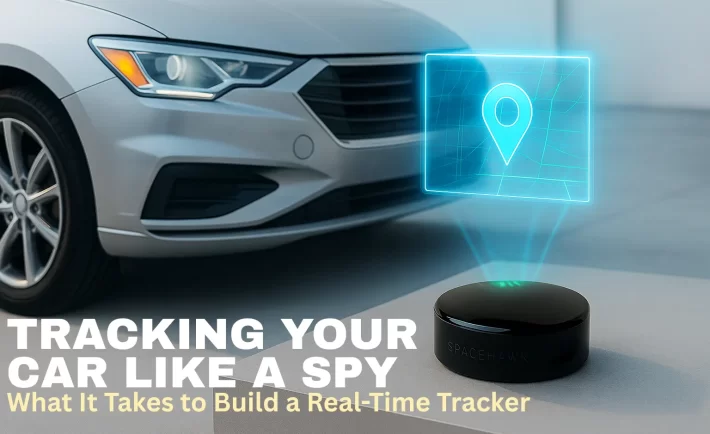
You’ve seen it in a dozen movies, the hero slides a tracker under a car, pulls up a glowing map, and watches a blinking red dot move across the city.
Guess what? That “spy gadget” isn’t fiction anymore. It’s in your pocket.
Welcome to the world of real-time GPS tracking, where anyone (not just secret agents) can follow their car’s every move, live, accurate, and totally legal.
And here’s the fun part, you could actually build one yourself… or skip the soldering iron and use something like the SpaceHawk Hidden GPS Tracker, that makes you feel like Bond without blowing up your weekend project.
In this guide, you’ll learn how these trackers actually work,what it really takes to build one from scratch.
We’ll break down the tech, the science, the pros and cons of DIY vs. professional trackers, and show you how GPS has quietly turned everyday drivers into their own secret agents — minus the tuxedo.
What Is a Real-Time GPS Tracker?
A real-time GPS tracker is a small device that constantly reports a vehicle’s location using satellites and cellular data. Unlike old-school GPS loggers (which just store routes), these devices send live updates to an app, every few seconds.
You’ll usually find them in three main flavors:
- OBD2 trackers that plug into your car’s port
- Hardwired trackers for fleets and company vehicles
- Portable magnetic trackers, like SpaceHawk, that snap under a car and run for weeks on one charge
In short, a real-time tracker acts like your private radar, a hidden car GPS tracker that keeps you updated on your vehicle, kids, or cargo in real time.
The Science Behind Tracking: How GPS Knows Where You Are
Here’s where the geek magic happens. A GPS tracker connects with at least four satellites orbiting 12,000 miles above Earth. Using a process called trilateration, it measures how long it takes signals to reach it from each satellite and then calculates its position with crazy precision.
Those coordinates are sent through a cellular network (4G LTE) to a cloud server, which updates your app in real time.
Basically: Space → Math → Modem → Map.
GPS satellites have atomic clocks that tick faster in space due to relativity and NASA actually corrects that so your car tracker doesn’t think it’s in the middle of the ocean.
How to Build Your Own Real-Time GPS Tracker
Alright, gadget lovers let’s talk DIY. If you’ve ever wanted to track your car like a spy and flex your inner engineer, building a real-time GPS tracker is the ultimate project.
But before you start soldering, let’s break down each part of the setup so you actually know what’s happening behind the scenes.
1. GPS Module: The Eyes in the Sky
Think of the GPS module as your tracker’s “eyes.” This tiny chip listens to signals from satellites orbiting Earth and uses a method called trilateration to figure out your exact coordinates (latitude, longitude, altitude).
Popular pick: NEO-6M GPS module.
What it does:
- Receives timing signals from at least four satellites.
- Calculates position down to a few meters.
- Outputs data in NMEA sentences (text lines your microcontroller can read).
The more satellites it can “see,” the better your accuracy. An open sky gives you pinpoint precision, while garages or dense cities can mess with reception.
2. GSM / SIM Module: The Messenger
Once you know where you are, you need a way to tell the world. So, you need a GSM module (like SIM800L or SIM900A), it’s your tracker’s communication link to the internet.
What it does:
- Uses a SIM card to connect to cellular networks (2G/3G/4G).
- Send your location data (from the GPS module) to a cloud server or directly to your phone.
- Can also receive commands like “send location now” via SMS or data packets.
How it works together: GPS gives you coordinates → GSM sends them out in real-time.
Always use a data plan with reliable coverage. Spotty networks = delayed tracking.
3. Microcontroller: The Brain of the Operation
Here’s the mastermind, the microcontroller. You can think of it as the translator and coordinator between your GPS and GSM modules.
Popular choices:
- Arduino UNO/Nano: simple and beginner-friendly.
- Raspberry Pi: for more advanced, web-connected projects.
What it does:
- Reads GPS data (coordinates, speed, time).
- Formats it into messages or logs.
- Send that data to your GSM module for transmission.
- Optionally, uploads everything to a cloud platform (like ThingsBoard, Firebase, or Blynk).
Arduino is great for low-power builds; Raspberry Pi shines when you want a full Linux environment, like running a live tracking dashboard.
4. Power Source: The Lifeline
Your tracker is useless if it dies halfway through a trip. That’s why power management is the trickiest part of any DIY build.
Options include:
- Lithium-ion or LiPo batteries: Rechargeable and lightweight.
- 18650 cells: Long-lasting and durable.
- Car’s power system (12V): For permanent installations.
What matters most:
- Battery capacity (mAh), the bigger, the longer it lasts.
- Voltage regulation, make sure it matches your modules (usually 3.3V or 5V).
- Power efficiency, your GSM module spikes power when sending data.
Add a small solar panel or sleep mode in your code if you want longer uptime.
5. Code + Cloud Service: The Digital Dashboard
Here’s where all your hard work pays off and turns raw data into a live map. You’ll need to write or upload code that:
- Reads the GPS coordinates
- Sends them via GSM to a server or cloud API
- Displays them on a map dashboard (like Google Maps, Ubidots, or ThingSpeak)
Basic flow:
- Arduino reads NMEA data from GPS.
- Code parses latitude & longitude.
- The GSM module sends this data to your cloud server.
- You visualize it in real-time through a simple web or mobile app.
If you’re new to cloud dashboards, start with free platforms like Blynk or ThingSpeak, they integrate beautifully with Arduino and Raspberry Pi.
You’ll solder wires, upload Arduino sketches, and manage power draw. If you’re geeky enough, it’s a fun weekend project. But here’s the catch: real-world conditions are brutal. Bad reception, dead batteries, and sketchy firmware can make your DIY tracker glitchier than a beta app.
Why Most DIY Builds Fall Short (and How SpaceHawk Gets It Right)
Sure, you can build one. But the real question is, should you?
DIY GPS trackers are fun experiments, but when it comes to real-world tracking, most homemade builds collapse under pressure. Here’s why:
- Weak antennas lose signal the moment you hide them under metal.
- Tiny batteries barely last a few hours.
- No mobile app, just raw coordinate data.
- No motion alerts or geofencing, so you can’t track activity in real time.
- Not weatherproof, meaning one storm can fry the whole setup.
The truth is, building your own tracker teaches you a lot, how satellites talk to receivers, how GSM modules transmit data, and how microcontrollers handle logic. But it also teaches one painful lesson: real-time tracking is easy to understand, hard to perfect.
That’s where the SpaceHawk Hidden GPS Tracker outperforms every DIY attempt and nails the mission.
Spacehawk GPS packs all that engineering GPS precision, 4G LTE connectivity, motion alerts, waterproof casing, and a slick mobile app, into one ready-to-deploy device.
In other words, while your DIY build is still figuring out how to get a GPS lock, SpaceHawk’s already on the move.
How SpaceHawk Makes Real-Time Tracking Effortless
SpaceHawk delivers professional-grade tracking performance and handles everything DIY trackers struggle with. Here’s what it actually gives you:
- Long battery life: Smart sleep modes and efficient reporting stretch runtime to weeks, not hours.
- 4G LTE connectivity: Fast, reliable location updates every few seconds across wide coverage.
- Strong magnetic mount: Holds tight under a vehicle without drilling or wiring.
- Waterproof ruggedness: Built to survive rain, road grime, and rough weather.
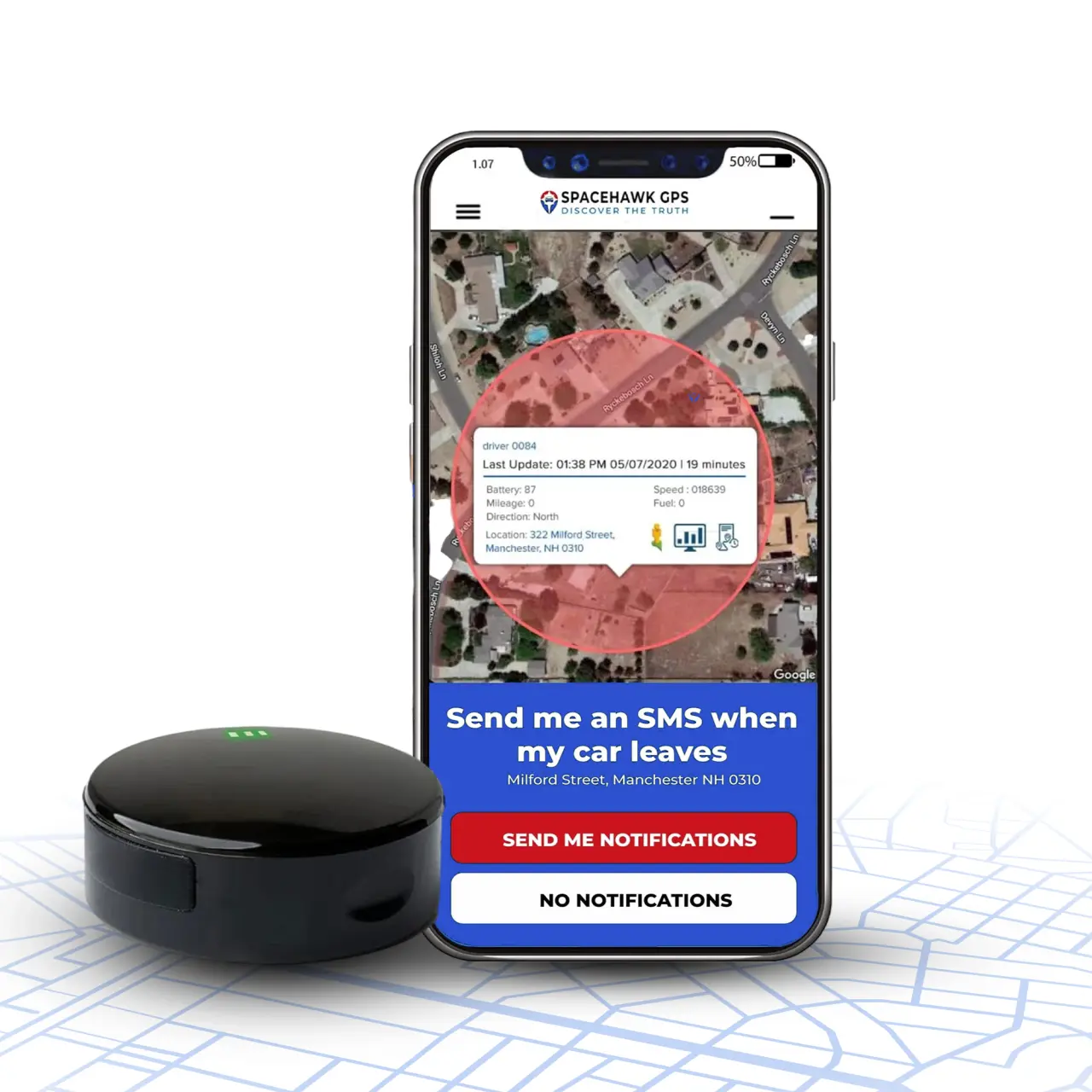
- App-first tracking: Live map, instant motion alerts, and geo-fence support in one simple interface.
- U.S.-based customer support: Help that’s actually available when you need it.
Think of SpaceHawk as your spy kit but without the headaches. It gives you real-time GPS tracking, theft protection, and fleet oversight in a compact, legal, plug-and-play device. No hacks, no soldering, and just secure, on-demand location data when it matters.
Real-World Uses: From Theft Prevention to Fleet Management
Let’s talk about where real-time GPS tracking actually saves the day.
1. Car Theft Recovery: Get instant motion alerts when your vehicle moves, even a few inches. If someone steals it, SpaceHawk shows exactly where it’s going.
2. Teen Driver Monitoring: Know when your teen gets home or if they take that “shortcut” again. Real-time insights give you peace of mind.
3. Fleet Management: For small businesses, GPS tracking saves gas, time, and stress. SpaceHawk lets you monitor every vehicle without hardwiring a thing.
4. Personal Asset Tracking: Attach it to trailers, bikes, or even boats and it’s small enough to go anywhere.
Each scenario proves one thing: GPS isn’t just cool tech and it’s practical protection.
The Legal & Ethical Side of Tracking
Let’s do a quick reality check, not every spy move makes the legal cut.
In the U.S., you’re fully within your rights to track what you own: your car, your business vehicles, or anything you have clear consent to monitor (like a company fleet or family vehicle).
But placing a tracker on someone else’s car without their permission? That’s crossing the line into a privacy violation, and it can get you into real legal trouble.
The SpaceHawk Hidden GPS Tracker is built for lawful, responsible use and helping car owners, parents, and fleet managers stay informed and protected without invading anyone’s privacy.
If you want to dig deeper, check out the Federal Trade Commission’s guidelines on location tracking. It’s always smart to understand the rules before you hit “track.”
Final Thoughts: From Geek Dream to Real-World Power
The idea of tracking a moving car used to belong to spy thrillers and secret agencies. Today, it fits in your hand.
Real-time GPS tracking has evolved from a geek fantasy into everyday tech, one that protects, informs, and empowers. Whether you’re a weekend builder or a driver who just wants peace of mind, this technology bridges curiosity and control.
You can absolutely build your own tracker, learn how satellites and sensors talk, and feel the thrill of watching your code bring data to life. But when you need something that just works reliably, accurate, and ready for the real world and that’s where SpaceHawk GPS earns its name.
Attach the tracker, power it up, and see your world come alive on the map in real time.
You don’t need a secret agency or a black SUV to track what matters, just smart tech built by people who think like you. That’s SpaceHawk: spy-level precision, made simple.
FAQs:
How does a real-time GPS tracker send data?
A tracker connects to multiple GPS satellites, calculates its location, and transmits that data through a 4G LTE network to a secure cloud server and instantly updates your mobile app with live movement.
Is it legal to track my own car?
Yes. You can legally track any vehicle or asset you personally own, manage, or have consent to monitor, such as family cars or company vehicles.
How accurate is the SpaceHawk GPS?
SpaceHawk delivers pinpoint accuracy, usually within a few feet as well as using advanced multi-satellite positioning and 4G LTE transmission for real-time updates.
Do I need to wire SpaceHawk into my car?
No wiring required. The SpaceHawk GPS is completely portable and attaches magnetically in seconds, making setup fast and hassle-free.
Can SpaceHawk alert me if my car moves unexpectedly?
Absolutely. The app lets you create custom motion alerts and geo-fence zones, so you’ll know the moment your vehicle moves, enters, or exits any area.