Fiber optic networks form the backbone of our digital world, delivering high-speed internet, streaming services, and seamless communication. The performance of these networks depends entirely on their quality. A single flaw can lead to slow speeds, frequent outages, and frustrated users.
Engineers implement rigorous quality control processes at every stage, from manufacturing to installation and ongoing maintenance, to prevent issues. Below, we’re going into greater detail about how engineers ensure quality control for fiber networks.
Pre-Installation Quality Control
Quality control starts long before any cable is laid. It begins with the components themselves. Engineers set strict standards for every piece of equipment that will become part of the network.
Material and Component Vetting
Engineers carefully select and test all materials. This includes the optical fibers, connectors, splicing equipment, and the protective sheathing that shields the fragile glass fibers from the environment. They work with manufacturers to make sure that every component meets specific performance criteria.
Key components undergo a series of tests:
- Tensile Strength: Engineers test cables to see how much pulling force they can withstand without breaking or compromising the fibers inside. This is crucial for the pulling process during installation.
- Environmental Resistance: Engineers subject cables to extreme temperatures, moisture, and chemical exposure to simulate real-world conditions and ensure they remain durable over time.
- Connector Quality: Connectors are microscopically inspected for any defects, dirt, or scratches that could cause signal loss. Even a tiny particle of dust can severely degrade performance.
By verifying the quality of each part before it reaches a worksite, engineers prevent future problems and ensure the network is built on a solid foundation.
Quality Control During Installation
The installation phase is where the network physically comes together, and it’s a critical point for quality control. Engineers and technicians must follow precise procedures to avoid introducing flaws that could compromise the entire system.
Precision Splicing and Termination
Splicing is the joining of two fiber optic cables together. Fusion splicing and mechanical splicing are the two primary approaches. Fusion splicing is the melting and fusing of two fibers, using an electric arc to create a nearly seamless connection with minimal signal loss. Mechanical splicing aligns the fibers and holds them in place with a small clamp.
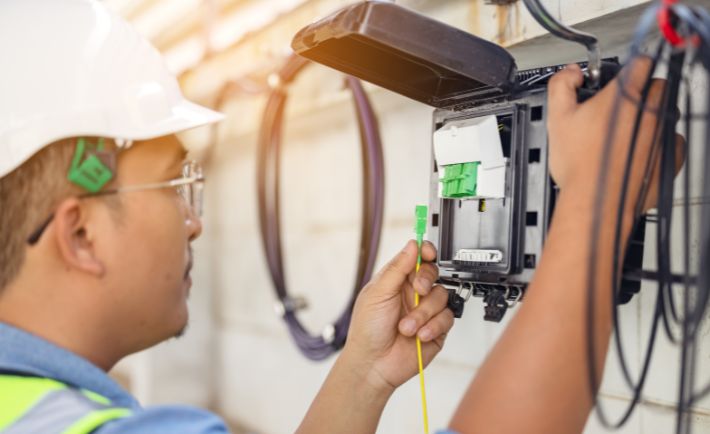
Engineers mandate strict protocols for splicing to ensure each connection is perfect. Technicians use high-precision cleavers to cut the fiber ends at a perfect 90 degree angle. They then align the fibers under a microscope before fusing them. After every splice, they use an Optical Time-Domain Reflectometer (OTDR) to test the connection. The OTDR sends a light pulse down the fiber and measures the reflection, allowing technicians to verify the splice quality and pinpoint the exact location of any faults.
Termination, the process of attaching connectors to the ends of fibers, also requires immense precision. Technicians must polish the connector ends to a mirror finish to ensure a clean light path.
Proper Cable Handling and Installation
Fiber optic cables, despite their protective sheathing, are sensitive. Bending a cable too tightly can cause microfractures in the glass fiber, leading to signal loss—a problem known as bend loss. Engineers establish a minimum bend radius for each type of cable to prevent this. Technicians must adhere to these limits, especially when routing cables around corners or through conduits.
Engineers also oversee the pulling tension applied to cables during installation. Using too much force can stretch the fibers and cause permanent damage. They specify the maximum pulling tension and ensure crews use equipment that monitors and controls the force applied.
Post-Installation Testing and Certification
After fully installing the network, it undergoes a final, comprehensive round of testing to certify its performance. This phase confirms that the network meets all design specifications and is ready for service.
End-To-End Performance Testing
Engineers perform end-to-end testing to measure the total signal loss, or attenuation, across the entire network link. They use an Optical Loss Test Set (OLTS), which consists of a light source at one end and a power meter at the other. This test provides a precise measurement of the total light lost as it travels from the transmitter to the receiver.
They then compare the results against a loss budget—a pre-calculated maximum acceptable signal loss for that specific link. If the measured loss exceeds the budget, engineers know there is a problem they must locate and resolve.
OTDR Trace Analysis
While the OLTS gives a total loss value, the OTDR provides a detailed map of the entire fiber link. The graphical output, called an OTDR trace, shows the length of the fiber and the location, type, and loss of every event, including splices, connectors, and sharp bends. Engineers analyze these traces to verify that each component is performing as expected.
The OTDR is an invaluable diagnostic tool for troubleshooting, allowing engineers to quickly find and repair faults that would otherwise be invisible. This is especially important for companies considering upgrading fiber network infrastructure, as it assesses the health of existing lines before adding new capacity.
Ongoing Monitoring and Maintenance
A fiber network requires continuous oversight to maintain its quality over its lifespan. Environmental factors, accidental damage, or component degradation can all impact performance.
Proactive Network Monitoring
Modern fiber networks feature sophisticated monitoring systems that track performance in real time. These systems detect subtle changes in signal strength or error rates, often before customers notice a problem.
When a potential issue is flagged, the system can automatically alert engineers, who can then use tools like the OTDR to investigate without having to physically inspect miles of cable. This proactive approach allows for predictive maintenance, where engineers fix problems before they cause an outage.
Routine Inspections and Audits
Engineers also schedule regular physical inspections of the network infrastructure. This includes checking outdoor cabinets for weather damage, ensuring cables are secure, and cleaning connectors at patch panels. These routine checks extend the life of the network and prevent service disruptions.
Your Connection’s Unseen Guardians
The seamless internet experience we often take for granted is the result of meticulous planning and relentless quality control. Engineers are the guardians of our digital infrastructure, working behind the scenes to ensure every component, every connection, and every meter of fiber meets the highest standards. Through rigorous quality control measures, precise installation practices, and proactive monitoring, engineers build and maintain the robust fiber networks that power our connected lives.