Open-world crime sandboxes have been a staple of mobile gaming for over a decade, and the formula barely changes: a city you can drive across, cars you can steal, missions you can ignore, and enough physics chaos to keep things interesting between objectives. Most of these games are single-player affairs with a thin layer of progression stapled on top. You finish the content, you leave.
The ones that hold attention longer are the ones that put other humans in the city with you. That shift from scripted AI traffic to actual players changes the texture of the whole thing. A stolen car matters more when someone else wanted it.
Where MadOut2 BigCityOnline fits in the open-world mobile crowd
MadOut2 BigCityOnline, from the developer listed as MadOut Games, sits firmly in the online camp. It’s categorized as Racing on the store, though that label undersells what the game contains: driving is the core verb, but the map is a full open world rather than a track.
The headline numbers do most of the explaining. The map covers roughly 10 square kilometers, and online mode supports up to 100 players on a single map at once. That player count is unusual for a mobile open-world title, and it changes what the city feels like during peak hours: you are rarely the only one on a given stretch of road.
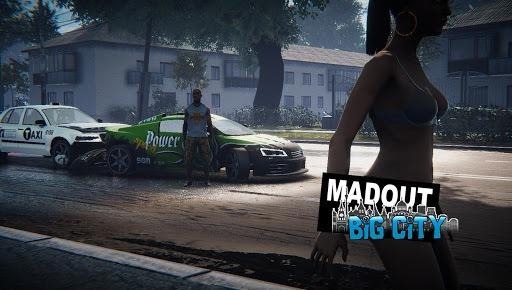
There are over 40 vehicle types to find and drive, with a physics model that includes visible destruction: bodywork deforms, parts come off, and collisions carry weight. The store listing calls out “crazy Russian cars,” which is an accurate description of the roster’s personality: boxy, loud, and prone to spectacular failure when you take a corner badly.
Missions, mayhem, and the rhythm of a shared city
Alongside free roam there’s a set of missions, giving players something to do when the server is quiet, but the game doesn’t push you toward them. A large portion of the appeal is unstructured: driving somewhere for no reason and seeing what happens.
That’s the trade-off here. If you want tightly designed quest chains and polished cutscenes, this isn’t that. If you want a big map, a lot of cars, destructible physics, and dozens of strangers making their own fun in the same space, the design holds up well.
Why a hundred players doesn’t mean a crowd
A hundred players spread across 10 square kilometers isn’t crowded in the way a battle royale lobby is. Encounters happen at intervals, usually in the denser downtown areas and along the main routes between districts, and convoys form, chases start by accident, and traffic jams occur because someone parked a truck sideways across a bridge.
It also means the experience varies a lot by session. Some runs are empty highway cruising. Others turn into twenty-car pileups.
Playing MadOut2 BigCityOnline on PC with an Android emulator
There’s no native Windows build, so getting this on a desktop means running the Android version through an emulator. The practical argument for doing so comes down to two things specific to this game: input and endurance.
Keyboard and mouse driving is a meaningful upgrade over touch controls here, mostly because the physics model rewards precise steering and throttle feathering that a virtual thumbstick flattens out. Mapping steering to WASD and the camera to the mouse makes free-look driving (watching for other players while holding a line) far less awkward than it is on a phone. Most emulators let you build a custom control profile per game, and MadOut2 is one of the titles where spending ten minutes on that profile pays off immediately.
The other factor is that this is a persistent online game with a big streaming map, and mobile hardware throttles under sustained load. The play MadOut2 BigCityOnline on PC guides worth checking before you join a 100-player server cover exactly that: draw distance and destruction effects are the two settings most likely to cost frames in the dense downtown blocks, and a desktop GPU handles both without the thermal cliff you hit on a handset after thirty minutes.
Because online mode is the main draw, a wired connection matters more than raw horsepower here. Packet loss in a shared city shows up as other players teleporting mid-chase, which is more disruptive than a slightly lower frame rate.
Who gets the most from the desktop version
If you mostly play in short bursts on a phone during downtime, the emulator route adds friction without much return. The real beneficiaries are the ones logging long sessions in online mode, chasing other drivers across the full 10 km map and caring whether their car responds the way they expect at speed. For that group, precise steering input and a machine that doesn’t throttle after half an hour is the difference between poking at MadOut2 for five minutes and putting real hours into it.